Best IT Courses in Nepal 2026: A Practical Guide to Starting a Tech Career
27-Nov-2026
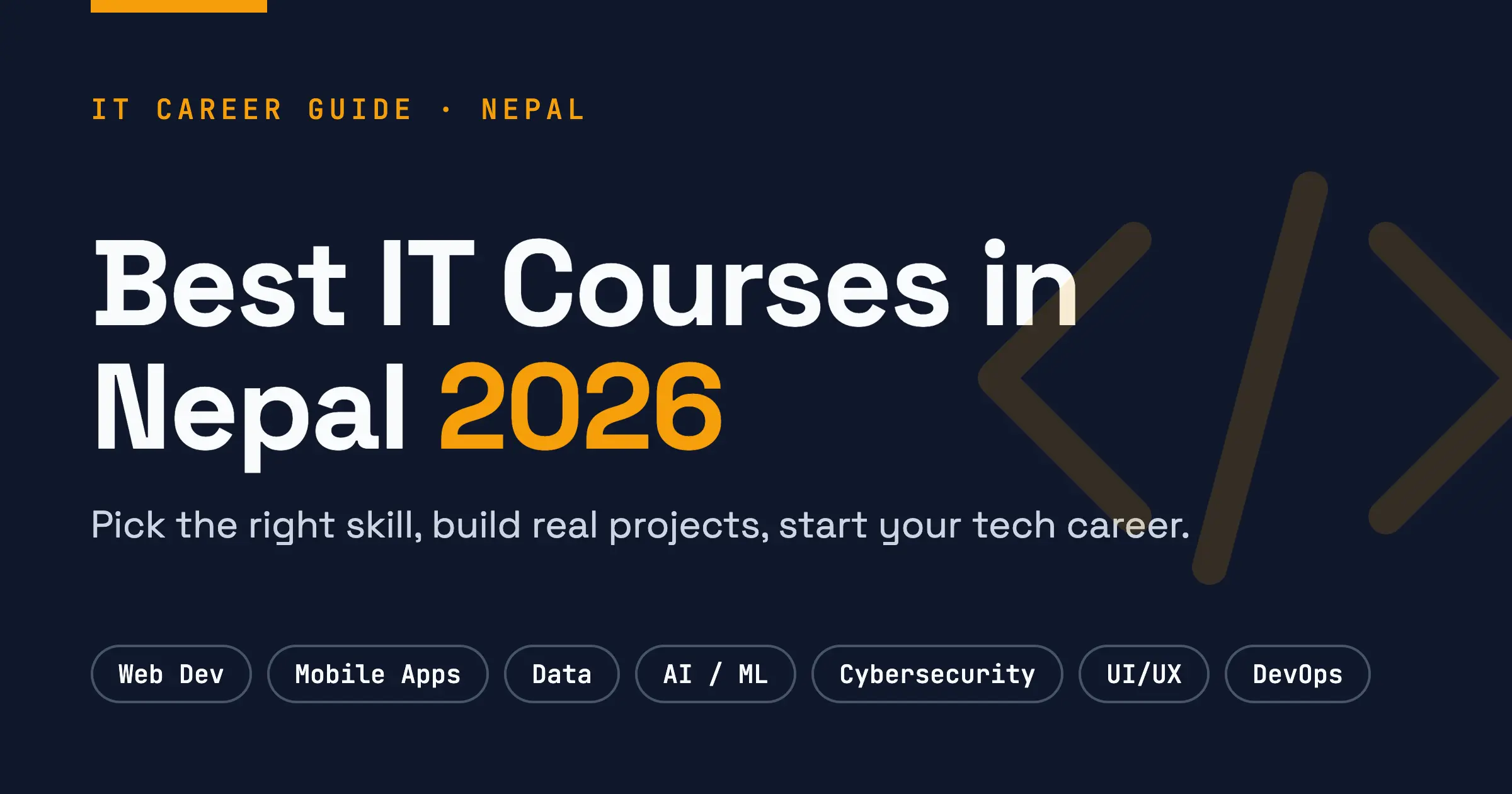
Nepal's tech scene is growing fast. Local startups, outsourcing companies, fintech platforms, and remote international jobs are all hiring, and employers increasingly care about what you can build rather than the degree on your wall. If you're wondering which IT course is worth your time and money in 2026, this guide covers the options with the best career prospects.
How to Choose an IT Course
Before the list, ask yourself three questions:
Does it teach practical skills? Look for courses where you build real projects, not just watch slides.
Is there demand for the skill? Check job portals and LinkedIn to see what Nepali and remote employers are asking for.
Does it fit your background and goals? A complete beginner needs a different path than someone switching careers.
1. Full Stack Web Development
Web development remains one of the most accessible and employable paths in Nepal. A good course covers HTML, CSS, JavaScript, a backend framework (Laravel, Node.js, or Django), databases like MySQL, and deployment.
Why it's worth it:
Every business needs a website, web app, or admin system
Strong demand from agencies, startups, and freelance clients
You can start earning through freelancing within months
Best for: Beginners who want the fastest route to a job or freelance income.
2. Mobile App Development
Flutter and React Native let you build Android and iOS apps from a single codebase, so companies hire for them heavily. Nepal's digital payment, e-commerce, and service apps keep generating demand.
Why it's worth it:
Smartphone usage keeps growing
Cross-platform skills make you useful to small teams
Flutter in particular has a strong, active community
Best for: People who enjoy building visual, interactive products.
3. Data Science and Data Analytics
Data skills are valuable in banking, telecom, retail, and NGOs. Courses typically cover Python, SQL, Excel, Power BI or Tableau, and statistics, with machine learning at the advanced level.
Why it's worth it:
Companies increasingly make decisions based on data
Data analyst roles are a good entry point before moving into data science
International remote opportunities are common
Best for: Analytical thinkers who are comfortable with math and spreadsheets.
4. Artificial Intelligence and Machine Learning
AI is no longer a niche subject. In 2026, knowing how to work with AI tools, APIs, and models is becoming part of the baseline for many tech roles. Courses range from practical AI-assisted development to deeper machine learning.
Why it's worth it:
Fast-growing field with global demand
Useful on its own and as an add-on to web, mobile, or data skills
Best for: Learners with a solid programming foundation, or developers who want to future-proof their skills.
5. Cybersecurity and Ethical Hacking
As banking, government services, and e-commerce move online, security matters more. Courses cover networking, Linux, web security, penetration testing, and certifications like CEH or CompTIA Security+.
Why it's worth it:
Fewer trained professionals than there are openings
Strong demand from banks, telecoms, and IT service companies
Best for: Curious, detail-oriented people who like understanding how systems break.
6. UI/UX Design
Good products need good design. UI/UX courses teach design principles, user research, Figma, prototyping, and design systems.
Why it's worth it:
A creative path into tech without heavy coding
Valued by both local companies and international clients
Best for: Creative people who care about how things look and feel.
7. Cloud Computing and DevOps
Companies are moving to AWS, Google Cloud, and Azure. DevOps courses teach Linux, Docker, CI/CD, and cloud deployment. These skills pay well but work best once you have some development or system administration experience.
Best for: Developers and IT graduates ready to move into infrastructure roles.
8. Digital Marketing and SEO
Not strictly "coding," but it's often grouped with IT courses and has strong demand locally. It covers SEO, social media advertising, analytics, and content strategy.
Best for: Entrepreneurs, marketers, and anyone who wants a tech-adjacent skill with a lower entry barrier.
Quick Comparison
Course | Difficulty | Job Demand | Freelance Potential |
|---|---|---|---|
Full Stack Web Dev | Medium | Very High | Very High |
Mobile App Dev | Medium | High | High |
Data Analytics | Medium | High | Medium |
AI / Machine Learning | Hard | Growing fast | Medium |
Cybersecurity | Hard | High | Medium |
UI/UX Design | Easy–Medium | High | High |
Cloud / DevOps | Hard | High | Low–Medium |
Digital Marketing | Easy | High | High |
Tips for Getting the Most Out of Any Course
Build projects. A portfolio of 3–5 real projects beats a certificate on its own.
Learn in public. Publish your code on GitHub and write about what you learn.
Practice English. Technical documentation, interviews, and remote work all depend on it.
Pick live or mentored classes if you struggle with self-discipline. Recorded courses work well only if you finish them.
Start earning early. Take small freelance or internship projects while you're still learning.
Final Thoughts
The "best" IT course depends on your interests, background, and goals. If you want the quickest path to employment, full stack web development is the safest choice. If you want to future-proof your career, add AI skills on top. Whatever you pick, commit to it, build real things, and stay consistent. The opportunities in Nepal's IT sector are real, and 2026 is a good time to start.