Python with Django Course in Nepal

Python with Django Course – Build Powerful Web Applications Using Python Framework

Python with Django

Looking for the best Python with Django course in Nepal?
Join the professional Python with Django Training at Code IT and learn to build powerful, scalable, and secure web applications using Python and the Django framework.

This hands-on backend development course is perfect for students across Nepal who want to master Python and Django, gain real-world experience, and develop job-ready skills in web development. You’ll work on dynamic, database-driven web applications, admin panels, and complete web projects used in professional environments.

Our training program offers live online classes accessible from anywhere in Nepal, along with hands-on classroom sessions in Dharan. Build practical experience, strengthen your backend development skills, and prepare for professional opportunities in web development and software engineering.

Create professional applications, build a strong development portfolio, and gain the confidence to work as a Python Django developer in Nepal’s competitive tech industry.

Prerequisites

Basic Git Knowledge
Having basic knowledge of HTML CSS and Python will give you a great advantage in this course.
Python with Django

Python with Django

Next batch starting soon

Mode: Online (Google Meet) Google Meet
Duration: 1.5 Month
Rs.2,499/-
Rs.16,500 Save 84%
Enquiry

Have any Question?

WhatsApp: 9862130505
Telephone: 025-575163

Everything You Receive

All-inclusive support — from training to real-world experience

Live Classes

Google Meet
7:00 PM - 8:00 PM

Lifetime Videos

Re-watch anytime

Certification

Industry recognized

Internship

Guaranteed 3-Month Internship

Course Curriculum

Everything you'll learn — from fundamentals to advanced concepts

What you will learn

  • Python & Django Fundamentals

  • Models & Database Management

  • Forms & User Input

  • Authentication & Advanced Features

  • Real-World Projects & Deployment

01 Introduction
Welcome & Curriculum Overview
A First Taste of HTML & CSS
How The Web Works
The Roles of HTML, CSS, and JS
Installing The Tools We Need
Configuring VSCode
02 HTML
Introduction
HTML Elements
HTML Attributes
Document Structure
HTML Comments
HTML Headings
HTML Paragraphs
HTML Links
HTML Images
Favicon
Page Title
Tables
Lists
HTML Block & Inline Elements
Divs
Span
HTML vs XHTML
03 HTML Layouts
Header
Nav
Section
Article
Aside
Footer
04 HTML Forms
Forms
Form Attributes
Form Elements
Input Types
Input Attributes
Input Form Attributes
05 CSS
Introduction
Inline CSS
Internal CSS
External CSS
CSS Colors
CSS Selectors
06 More CSS
CSS Flexbox
CSS Grid
Responsive Design
07 Tailwind CSS
Introduction
Installation
Editor Setup
Utility-First Fundamentals
Hover, Focus & Other States
Responsive Design
Reusing Styles
Dark Mode
Functions & Directives
Layouts
Aspect Ratio
Container
Columns
Flexbox
Grid
Spacing
Sizing
Typography
Backgrounds
Border
Effects
Filters
Transformations
08 JavaScript
Introduction
JS Variables
JS Constants
Objects
Arrays
Functions
Types of Functions
Operators
Control Flow
09 Understanding the DOM and Event Handling
Basic DOM manipulation
Event listeners and event handling
Form handling and validation
10 Advanced JavaScript Concepts
Callback functions
Promises and async/await
Event loop and asynchronous programming
Error handling (try,catch,finally)
11 Working with Objects and Arrays
Object properties and methods
Array methods (map,filter,forEach,find)
Destructuring assignments
Spread and rest operators
12 Modules and ES6+ Features
Importing and exporting modules
Template literals
Default parameters
Object and array destructuring
Enhanced object literals
13 Introduction to Python
Introduction to Python and its feature
Installing Python and setting up development environment
Basic syntax and data types (variables, numbers, strings, lists, tuples, dictionaries)
Assignments
14 Functions and Modules
Introduction to functions
Defining and calling functions
Parameters and arguments
Return statement and function scope
Assignments
15 Data Structures
Lists: methods and operations
Tuples and sets
Assignments
16 Data Structures and File Handling
Dictionaries: methods and operations
File handling: opening, reading, writing, and closing files
Assignments
17 Advanced Topics in Python
List comprehensions
Lambda functions
Assignments
18 Advanced Topics in Python
Generators and iterators
Decorators
Assignments
19 Review and Practice
Review of topics covered so far
Practice exercises and coding challenges
Assignments
20 Object-Oriented Programming (Part 1)
Introduction to OOP concepts (classes, objects, attributes, methods)
Defining classes and creating objects
Assignments
21 Object-Oriented Programming (Part 2)
Instance and class variables
Constructors and destructors
Assignments
22 Object-Oriented Programming (Part 3)
Inheritance and polymorphism
Method overriding and super() function
Assignments
23 Object-Oriented Programming (Part 4)
Encapsulation and information hiding
Introduction to special methods (magic methods)
Assignments
24 Attractive Python Libraries
Introduction to NumPy for numerical computing
Introduction to Pandas for data manipulation and analysis
Assignments
25 Introduction to Django
Overview of Django framework
Advantages of using Django
26 Setting up Development Environment
Installation of Python and Django
Setting up a virtual environment
27 Creating Your First Django Project
Understanding project structure
Creating and configuring a new Django project
28 Exploring Django Admin Interface
Creating superuser
Managing models using admin interface
29 Django Models
Defining models and fields
Relationships between models (OneToOne, ForeignKey, ManyToMany)
30 Django Views and URLs
Creating views to handle HTTP requests
Mapping URLs to views using URL patterns
31 Templating with Django
Introduction to Django templates
Creating dynamic web pages using templates
Template inheritance and reusable components
32 Django Forms
Creating forms using Django Form class
Handling form submissions and validation
33 User Authentication
Implementing user authentication and authorization
Building login, registration, and logout functionality
34 Cross-Site Request Forgery (CSRF) protection
Understanding CSRF attacks
Implementing CSRF protection in Django forms
35 Django ORM (Object-Relational Mapping)
Performing database queries using Django ORM
Database migrations and schema evolution
36 Django Middleware
Creating custom middleware for request/response processing
Implementing middleware for authentication, logging, etc.
37 Django Signals
Understanding Django's signal framework
Using signals for decoupled communication between components
38 Introduction to Django REST Framework (DRF)
Overview of DRF and its features
Serializers, views, and viewsets in DRF
39 Building RESTful APIs
Creating API endpoints for CRUD operations
Handling authentication and permissions in DRF
40 Writing Unit Tests
Writing tests for Django applications using built-in testing tools
Testing models, views, forms, and API endpoints
41 Debugging Django Applications
Using Django's debugging tools for troubleshooting
Debugging common issues in Django applications
42 Deploying Django Applications
Configuring Django settings for production
Deploying Django applications to popular hosting platforms
43 Scaling Django Applications
Optimizing performance for high traffic
Horizontal and vertical scaling strategies
44 Final Project Development
Working on a real-world project to apply Django concepts
Implementing features such as user authentication, CRUD operations, and RESTful APIs
45 Project Showcase
Presenting final projects to the class
Demonstrating project functionalities and discussing implementation details
46 Continuing Your Django Journey
Exploring advanced Django topics and resources for further learning
Contributing to open-source Django projects and communities
47 Networking and Career Opportunities
Connecting with Django developers and industry professionals
Exploring job opportunities in Django development sector

Earn Your Certification

After completing the course, you will receive a professional certificate from Code IT, verified by industry leaders in Nepal.
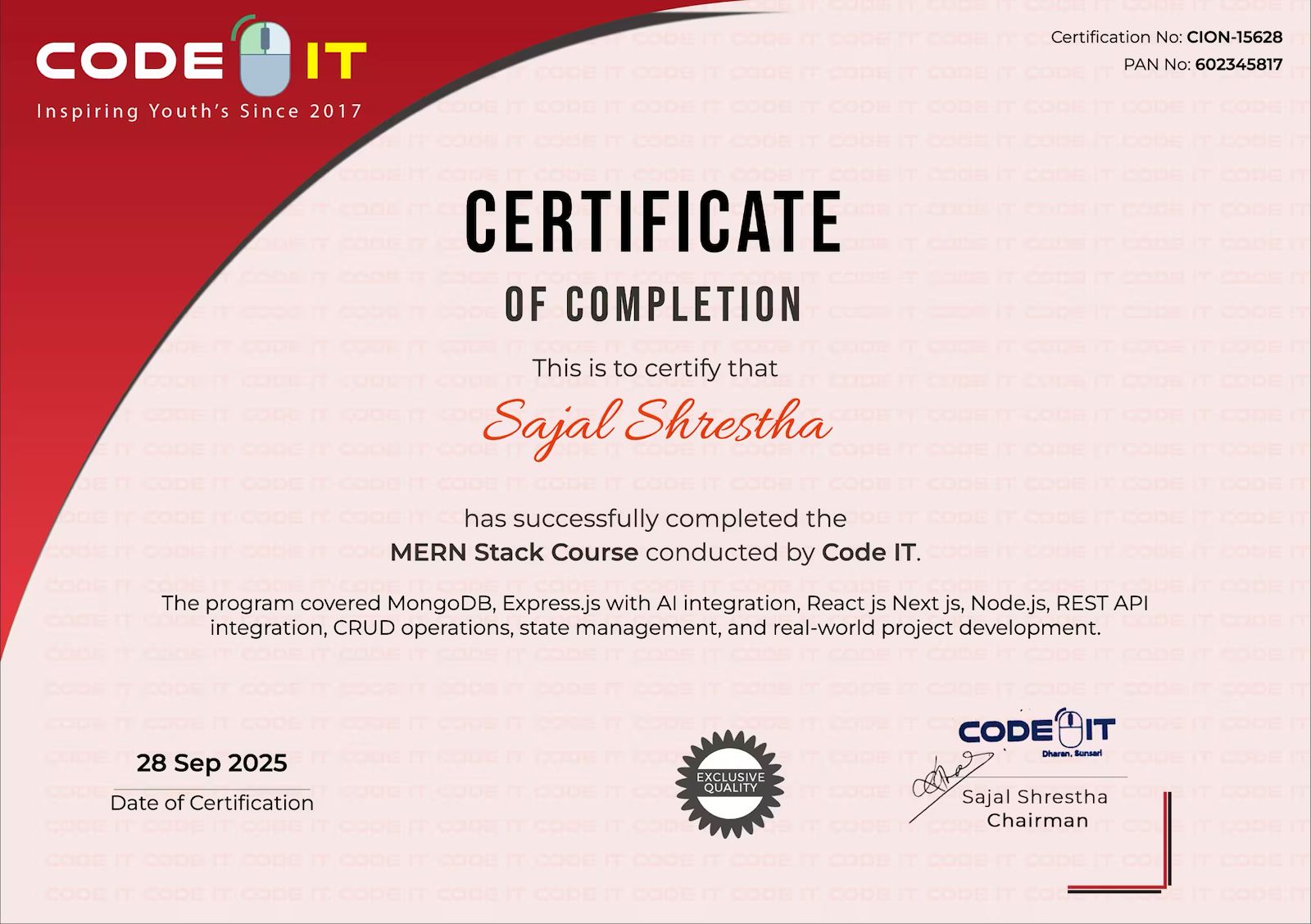
Share your achievement with pride on LinkedIn.
Certificate

Course Mentors

Learn directly from industry experts with years of hands‑on experience

Prakash Tajpuriya

Prakash Tajpuriya

Sr. Full Stack Developer

Code IT, Nepal 6+ Years of Experience
Get in Touch

Need More Information?

Our team will respond within a few hours

Why Enquire?

Payment plans & installment options
Certificate & accreditation details
Course level & suitability check
Flexible batch timings
Career guidance & job support

Join 100k+ successful graduates

We'll respond within 2-3 hours during business hours

Watch Demo Video

Python with Django

Open on YouTube ↗